

Will AI Replace Architects? Not Even Close. Here’s What’s Really Happening.

If you’ve been paying attention to the headlines, you’ve probably heard it before:
"AI is coming for everyone’s jobs.” Architecture is no exception.
But here’s the reality—AI isn’t replacing architects. It’s changing how they work.
And in many ways, it’s making the profession more important than ever.
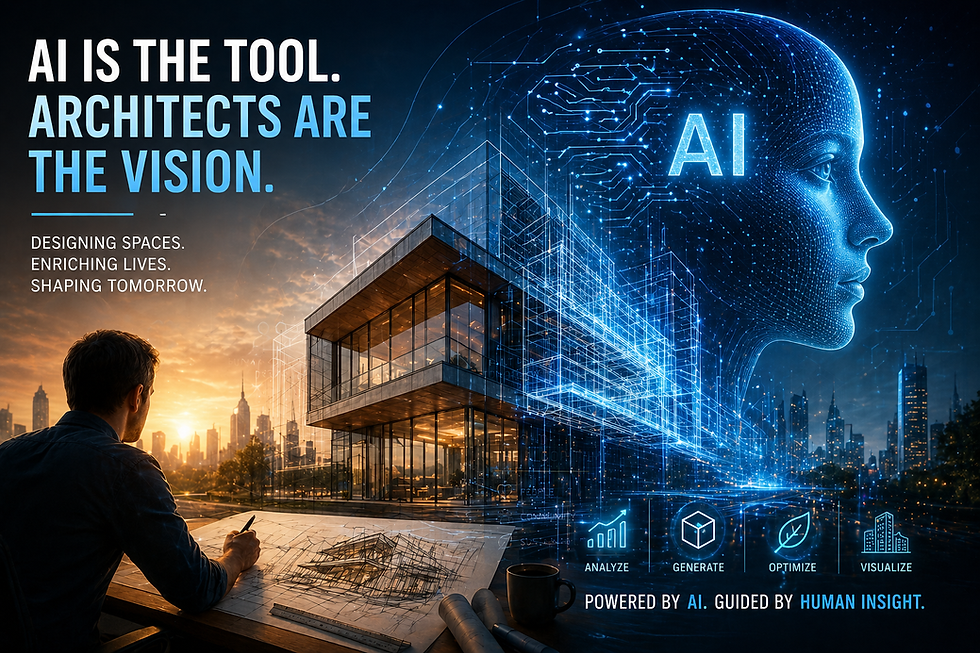
A Quiet Problem Most People Don’t See
Here’s something that might surprise you:
The United States actually has fewer architects per person today than it did decades ago.
At the same time, many experienced architects are retiring, and fewer young professionals are becoming licensed.
Why does that matter?
Because architects aren’t just designers—they’re responsible for the safety, functionality, and long-term performance of the spaces we all use every day:
Schools
Hospitals
Offices
Homes
Public spaces
In other words, the demand for thoughtful, responsible design isn’t going anywhere.
So Where Does AI Fit In?
AI is already being used in architecture—just not in the way people imagine.
It’s not sitting down and “designing buildings” on its own.
Instead, it’s helping architects:
Test hundreds of design ideas in minutes
Analyze energy efficiency and building performance
Check building codes more quickly
Create visualizations that help clients “see” a project before it’s built
Think of it less like a replacement—and more like a supercharged assistant
.

What AI Can’t Do
Here’s the part that often gets overlooked:
Architecture isn’t just about drawings or data.
It’s about people.
A real architect has to:
Make judgment calls that affect public safety
Interpret complex building codes and regulations
Coordinate engineers, contractors, and clients
Take legal responsibility for the final design
AI can’t sign drawings, AI can’t be held liable, AI can’t stand behind a building if something goes wrong, and beyond that, AI can’t replicate the human side of design:
Understanding how a space should feel
Responding to a community’s identity and culture
Turning a client’s vision into something real
A Tool—Not a Threat
If this all sounds familiar, it should.
Architecture has gone through major shifts before:
Hand drafting gave way to computers
Computer drawings evolved into 3D building models
Each time, the tools changed—but the architect’s role didn’t disappear. It evolved.
AI is just the next step in that progression.
The architects who will thrive aren’t the ones who resist it—they’re the ones who learn how to use it.
Why the Human Element Still Wins
At its core, architecture has never been just about buildings—it’s about people.
While AI can process data, generate options, and improve efficiency, it doesn’t experience the world the way we do. It doesn’t understand what it feels like to walk into a space for the first time, to feel welcomed, inspired, safe, or connected. Those qualities come from human insight—shaped by experience, emotion, and an understanding of how people live, work, and interact.
Architecture requires judgment, and not just technical judgment—but human judgment.
Every project involves a series of decisions that go beyond numbers:
Balancing budget with long-term value
Navigating competing stakeholder priorities
Responding to community identity and culture
Making trade-offs that impact real people
These are not purely logical problems—they are human problems, and they require human solutions.
There is also a level of accountability that defines the profession. Licensed architects are responsible for life safety, code compliance, and the integrity of the built environment. They coordinate teams, resolve conflicts, and ultimately stand behind the work. That responsibility carries legal and ethical weight—something no software or algorithm can assume.
And then there’s creativity. Not just in form or aesthetics, but in problem-solving—finding a way forward when constraints, regulations, and real-world conditions don’t line up neatly. Great design often comes from navigating ambiguity, not just optimizing inputs. AI can assist in that process, but it doesn’t replace the instinct, experience, and perspective that drive meaningful design decisions.
In the end, people don’t connect with buildings because they are efficient—they connect with them because they are thoughtful, purposeful, and human-centered.
That’s why, even in an age of rapid technological advancement, the human element doesn’t just remain relevant—
it becomes even more essential.
Looking Ahead
Artificial Intelligence will continue to reshape the architecture profession—there’s no question about that. It will make processes faster, improve coordination, and unlock new ways of exploring design. Data will become more accessible. Early decision-making will be more informed than ever before.
But the future of architecture still depends on people—especially the next generation of architects stepping into the profession. And that’s where mentorship, experience, and leadership come in. Because behind every well-designed building, there’s still something AI can’t replicate.
With all of that progress comes an important truth:
The more powerful the tools become, the more critical human judgment becomes.
Architecture is not simply a technical exercise—it is a profession grounded in responsibility. Every building affects human life, safety, and well-being. Behind every school, hospital, and public space is a licensed professional who is legally and ethically accountable for the outcome. That level of responsibility cannot be delegated to an algorithm.
AI can generate options.AI can analyze performance. AI can even suggest solutions.
But AI cannot stand behind those decisions, It cannot take responsibility for life safety. It cannot navigate the nuances of conflicting codes, political realities, and human needs. It cannot sit across from a client, listen to concerns, and translate them into something meaningful and buildable.
And perhaps most importantly, AI cannot understand the human experience of space—how a building feels, how it serves a community, or how it contributes to a sense of place.
As we look forward, the role of the architect is not diminishing—it is evolving and
becoming more focused.
The architect of the future will be:
A decision-maker, not just a producer of drawings
A leader and coordinator, guiding increasingly complex teams and technologies
A steward of public safety and trust
A translator, bridging human needs with technological capability
A creative problem-solver, using tools like AI to enhance—not replace—design thinking
There is also a broader industry reality that cannot be ignored. With fewer architects per capita and a wave of retirements underway, the profession is facing a gap at precisely the moment when our built environment is becoming more complex and demanding. From climate-responsive design to evolving codes and community expectations, the need for experienced, licensed architects is only increasing.
This is where the human element becomes irreplaceable.
Technology can accelerate the process—but it cannot replace experience, accountability, and judgment. Those are earned over time, shaped by real projects, real challenges, and real consequences.
The future of architecture will not be defined by AI alone. It will be defined by how well architects use AI while maintaining control, responsibility, and vision.
In the end, buildings are not designed for machines. They are designed for people.
And that means there will always be a need for architects—not just to design them, but to stand behind them.
Images are for illustrative purposes only. Any resemblance to characters from the Terminator franchise is incidental; all related intellectual property belongs to its respective owners. No affiliation or endorsement is implied.


Comments